
He Started Running to Lose Weight, then Something Shifted.
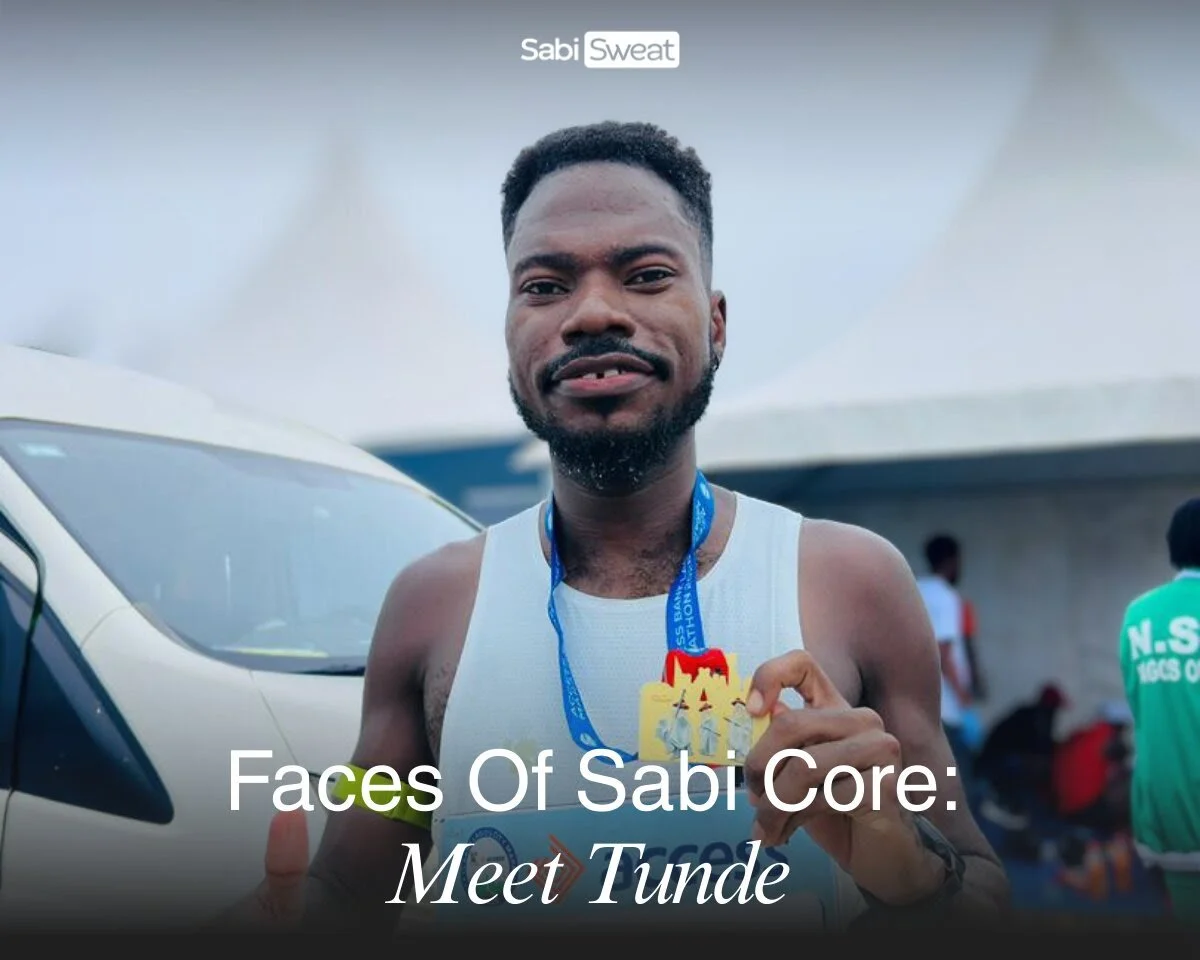
The Faces of Sabi Core series highlights real stories from our community. This week, we're spotlighting a marathoner who joined us at the Marathon Eve Shake Out Run before running the full 42.2KM Lagos City Marathon; his journey to the start line, what happened during the race, and what crossing that finish line meant to him.
Tunde Fabusola is 31, a run coach and content writer based in Lagos. He works primarily with busy professionals, helping them build endurance, improve speed, and rethink the way they approach training.
The Lagos City Marathon 2025 was his debut marathon. He had been running consistently for just two months when he signed up, and he crossed the finish line in 3 hours and 44 minutes. A year later, he returned to the same race with one goal: see how much he could improve if he approached the process more intentionally.
He joined us for the Marathon Eve Shake Out Run the night before race day, and on February 14th, 2026, he finished the marathon race in 3 hours 3 minutes, shaving 41 minutes off his debut time.
We had a chat with him about the journey, the race, and what crossing that finish line meant to him.
“The strongest emotion that hit me was quiet fulfillment. It was proof that consistent effort compounds. Now, I feel motivated more than anything else. It feels like a foundation for the next level.”
Q: Was this your first marathon race, or have you done this before? What distance did you run, 10KM or 42.2KM; and why that distance?
Tunde: I ran the full marathon, 42.2KM. This was my second time running the distance. I ran my first marathon last year. I'm drawn to the marathon because it represents the purest test of endurance. It's not just about speed. It's about patience, discipline, emotional control, and how well you can manage yourself over a very long period of discomfort.
Q: Before deciding to run the Lagos Marathon, what had your relationship with movement been like? Were you always active, or was this a new chapter for you?
Tunde: Before deciding to run my first Lagos City Marathon, I had only been running consistently for about two months. I initially started running because I wanted to lose some weight. That said, I had a very active childhood. I played tennis, did gymnastics, and participated in sports recreationally while in secondary school. I also did a lot of cycling during the pandemic. So while running itself was new, movement wasn’t completely foreign to me. This was still a new chapter, but it felt like something my body adapted to quickly.
Q: What made you sign up for the marathon in the first place? Was there a specific moment or reason that pushed you to commit?
Tunde: I signed up for my first marathon out of curiosity. I had just discovered structured training and wanted to see how far I could take it. I ran and completed my debut marathon in 3 hours 44 minutes. After that, I knew I had only scratched the surface of what I was capable of.
Signing up again wasn’t just about finishing. It was about seeing how much I could improve if I approached the process more intentionally. It became a long-term project of personal improvement.
Q: Did you train for this race? If so, what did your training look like, and what was the hardest part that you didn't expect going in?
Tunde: Yes, I trained. My training was very structured and consistent. I was running between 80 and 135km per week at different phases of the build-up. My training included long runs, marathon pace workouts, threshold sessions, and a lot of easy mileage to build aerobic capacity for the time I was targeting.
The hardest part wasn’t any of the workouts I did. It was maintaining consistency over several months. Showing up day after day, even when tired, and adapting when conditions weren’t ideal.
What surprised me most was how much mental discipline and adaptability the process required.
“We didn’t have enough gels for the full marathon before the shake out and we left with more than enough for the race and even gave some to others”
Q: You joined us for the Lagos Marathon Eve Shake Out Run; how did you hear about the event, and what made you decide to sign up for the shake out? Looking back, are you happy you showed up that day?
Tunde: I saw the event’s flyer on Instagram, Rodiat shared the post from Sabi Sweat to her Instagram story. The partnership with SIS stood out to me so I decided to sign up and tell my guys about it. It can really be a challenge to get energy gels in this part of this world. Nutrition is one of the things most recreational runners don’t take seriously here and that always impacts performance and recovery in both short and long term.
I was convinced; I still am, that the Sabi Sweat is knowledgeable about the benefits of nutrition and recovery to care enough about such a collaboration.
I’m really glad I and my guys signed up. We didn’t have enough gels for the full marathon before the shake out and we left with more than enough for the race and even gave some to others who didn’t have because Deborah insisted on 42.2km runners having more than enough . Thank you guys so much. The gels really helped and the meal from Danfo Bistro too.
Q: Take us through race day. What was going through your mind at the start line? And then during the race; when did it get tough, and how did you push through?
Tunde: I arrived at the start line just two minutes before the race began because of traffic, so I didn’t get a proper warm up. I had to stay calm, do a few quick dynamic movements, and trust my preparation. In the first half of the race, my focus was on restraint. Most runners start too fast, but I stayed controlled and was able to run with a group that maintained a steady pace.
The second half was significantly harder because we were running into a strong headwind. It required more effort to maintain the same pace. At that point, my focus shifted to staying present and maintaining forward momentum. In marathon racing, you learn that progress comes from continuing to move forward, even when it becomes uncomfortable.
Q: When you crossed that finish line, what did that moment mean to you? What emotions hit you first? And now that it's done, how do you feel?
Tunde: Crossing the finish line in 3 hours, 3 minutes was deeply satisfying. Not just because of the time, but because of what it represented. It reflected months of disciplined work, patience, and belief in a long-term process.
The strongest emotion that hit me was quiet fulfillment. It was proof that consistent effort compounds. Now, I feel motivated more than anything else. It feels like a foundation for the next level.
Q: Has completing this race changed anything about how you see yourself or movement in general?
Tunde: Yes. It reinforced the idea that both the body and mind adapt to the level of demand you place on them. Movement has become a tool for personal growth. It has taught me patience, resilience, and long-term thinking. It also showed me that improvement is almost always possible when you approach the process with enough consistency and intention.
This isn’t the end for me. My goal now is to improve my personal best in short distances like 5km & 10km which I will then turn to marathon readiness and improve by another 5 to 8 minutes in my next marathon.
“Movement has become a tool for personal growth. It has taught me patience, resilience, and long-term thinking.”
We couldn't be prouder of Tunde and every runner who showed up, trained hard, and trusted the process.
Tunde called it "quiet fulfillment", that specific feeling when months of unglamorous, consistent work finally shows up on a clock. No shortcuts produced that number, just showing up, repeatedly, over a very long time.
Most people are more capable of this than they believe. Whatever you're building; a race, a habit, a version of yourself you haven't met yet, the process Tunde trusted is the same one waiting for you. The only question is: Are you're willing to trust the process long enough to find out?
We are rooting for you,
